EXHIBITIONS 2021 / 2022
Elena Štrok: Baby Universe
September 10th - October 8th 2021
_page-0001.jpg)
Perceivance of life resembles wandering through a silent winter forest pervaded with a soft, barely perceptible fog. In the forest, we run into figures speaking of the adventures of their previous springs, summers and autumns, all of them having happened in the same place. Each of them tells their own story, yet the forest and events are, objectively speaking, the same. As Joseph Campbell states, all great stories are, in fact, variations of a single story narrated by different characters, at a different time in a different way. The truth is essentially unambiguous and immutable. In one of his interviews, Campbell mentions that due to the nature of cultural and temporal settings we live in, a man no longer manages to create widely accepted mythological structures and archetypes for the development of an individual and concludes that the only solution is to create a mythological space on our own. The concept of an idol is necessary in the comparison, which helps us to build our identity. Heroes and idols are an embodiment of ideals admired by a particular culture and the need for them has never faded away, but has nowadays switched to bright screens, either in the form of (fictive) film characters and games or in the form of celebrities. Science has also taken the role of a mythological space to a great extent, which automatically changes the way a man perceives themself. The same concept is accepted by an astrophysicist Joseph Silk, referring to the chapter Cosmologists and their Myths from his book Cosmic enigmas: ''In many respects, the Big Bang is to modern cosmology what mythology was to the ancients.'' A performative epic fairytale Baby Universe is based on the foundations of ancient ideals, embodied through a simple story in figures of planets faced with the threat of their own mortality. The generally almighty gods / planets found themselves in a situation that they no longer have absolute control, regardless of their martial, thoughtful and other skills. The instinct in each of them arouses the weaknesses they normally effortlessly control. The solution is brought by Pluto, the deity to whom death is not an unknown term, and in whose words a tranquil thought which encloses the analysis. The final outcome remains unknown. The work symbolically foreshadows the equilibration of opposites, reconciliation of archetypes, appreciation and calibration necessary to all of us at a certain point. Returning to ''their homes'', all of the planets will draw from Pluto’s words what they wish and are able to. With a dash of humour, Baby Universe becomes a memento mori, with an emphasis on a positive, not so burdened perception of mortality. ''Nagual Julian used to tell me (…) about great conquerors, military leaders from ancient Rome. Upon their return to Rome, the citizens greeted them with great triumphal celebrations held in their honour. Showing the treasure they took and people they enslaved, the celebrants were driven around standing on their chariots. Next to them, a slave was riding a horse, with a single task of whispering to them that glory and fame were transient.'' After graduating from gymnasium and secondary music school in Varaždin as a musician guitarist, Elena Štrok (b. 1996., Varaždin) also completed the undergraduate study programme in graphic arts at the Academy of Fine Arts in Zagreb, with a special Magna cum laude honor award, where she is currently completing graduate programme in prof. Mirjana Vodopija's class. She has participated in international and local projects in fields of visual arts, music and performance. So far, she has exhibited and performed in Croatia, Slovenia, North Macedonia, Latvia, Czech Republic, Greece and Portugal. In 2019, within the Erasmus+ student exchange project, she spent the final semester of her BA studies at the Academy of Fine Arts in Prague in the class of prof. Pavla Scerankova and prof. Dušan Zahoranski. Afterwards she participated in an Erasmus + internship in the residential house for artists De Liceiras 18 in Porto, Portugal. Along with a few colleagues, she took part in the establishment of Eklipsefemero cultural organization, which aims to achieve an international promotion, connection and networking among artists and the organization of cultural events. In her work, she aspires to bring art and philosophy closer to people in both public and institutional frameworks by using narration as her main medium of expression.


Theories of comfort
participatory exhibition
November 12th - 26th 2021

In a world that is going through changes that affect the daily life of an individual, we are faced and left to ourselves to find appropriate coping mechanisms with the fear that this kind of objective uncertainty brings with it. The pandemic crisis affects all spheres of human life - from existential and life security to relationships with other people. In the impossibility of knowing about the end of the current crisis, where the only thing certain is that some changes are permanent, the need for security comes as a collective experience. The notions of safety and comfort have acquired, in a time and society that operates on multitasking and precarious working conditions, a pejorative connotation. Nevertheless, the pandemic crisis has shown that spaces, habits and rituals that provide security to an individual, in conditions of forced isolation and a lack of social activities, are necessary for a person's personal development. The feelings we are faced with in the situation we collectively experience can be defined as grieving. We grieve because the world is changing irrevocably, we are not comforted by the temporary nature of this collective experience, and we fail to find comfort in its transience. This kind of grief is revealed as a collective experience, but it can also be characterized as anticipatory grieving, i.e. as the kind of grief that occurs in response to the fact that neither the individual nor the collective can be sure of what the future holds. It is a sadness that "runs" into the future and imagines the worst scenarios. At the same time aware that the known / established / "normal" patterns of coexistence are lost and do not provide us with emotional support that helps to cope with everyday stress, we have to turn to those known mechanisms of coping with grief - rituals, habits and things in which we are used to find comfort and safety. The Theories of Comfort exhibition is based on a collective reflection on current situations in which we try to find answers to collective fear and discomfort, by researching new art forms. Through a public call, we collected the contributions of forty participants, who took part in the creation of the exhibition, either by borrowing a book and indicating the part they want to share with others, or by virtually sending paragraphs that are significant to them. The exhibition is part of Komfortacije project, which aims to awaken a sense of comfort and collective security through reading - the text (literary, theoretical) in this case is revealed as a starting point for shaping the mechanisms of coping with the grief we are faced with today. Through monthly reading groups and radio shows, weekly newsletters and performative workshops, we contrast the so-called theories of comfort with the so-called theories of fear, and in this way we encourage the participants and the wider audience to fulfil their daily lives by reading, to find comfort and inspiration. The project is being implemented from July to December 2021, with the support of the Ministry of Culture and Media of the Republic of Croatia as part of the Public Call for proposals for programs that encourage reading in the Republic of Croatia for the year 2021.


Ana Vuko: Južina*
February 22nd - March 22nd 2022
* Južina - the state of the weather in the Adriatic when the south wind blows and when people feel uncomfortable due to high humidity and wind
_page-0001.jpg)
Ana Vuko was born in Split, where she spent most of her formative years. She has been living in Zagreb for the last ten years and, as she claims, identifies herself "as a woman from Split, which comes with certain connotations and expectations". On several occasions, warned that she does not talk in the native dialect, and that she has lost her identity because of that, she spent a lot of time thinking about the meaning of that statement and finally took it as a starting point for a series of photographs that she started making in 2020. For the exhibition in Prostor, she creates a new part of the series in which she focuses on Spinut, the neighbourhood in which she grew up and in which Prostor is located. Extending to the public space, the exhibition area expands with a series of self-referential scenes, which are located in the aisles of the building and replicate elements of dominant modernist architecture of the neighbourhood. In a culture where people are often judged exclusively on the basis of their place of origin, and their value is determined on the basis of knowledge about that place and the mental image we have of it, južina, as a specificity of the climate from which the author comes, served as the main motive. In addition to symbolizing the specific state that it allegedly induces, and which is reflected in the mentality of the area, južina gives the photos a specific tone, so the photographs of Spinut are dominated by light grey, beige and blue tones, making it look the way the author herself experiences it, thus creating a synesthetic experience of the place. At the same time, she wants to portray Južina as it is, in all its "dirtiness" and chaos, consciously choosing it because of the light it creates, but avoiding the need for making it dramatical. Photographs are created intuitively, by revisiting the places to which she binds certain memories, thus enabling psychological transfer in both directions - transferring her own experience of a certain place to photography, which she receives back in the same way through photography. The photos do not record the changes, but portray the totality of everything a place is. Južina is therefore a photo-series of self-reflections on one's own identity that questions how much the origin influences the identity in one's own consciousness and in the consciousness of others, and to what extent the place of origin creates differences in the perception of social affiliation. It is also questioning a common love-hate relationship with the city, in which one of these two extremes often prevails. On the topic of creating a subjective portrait of the city, the author will say: Exploring places in Split that are personally significant to me, I intuitively record my own projections with the help of a camera. How many of myself can I find there? Am I, apart from the obvious characteristics, mirroring the city I come from? Does it mirror me? Ana Vuko is a designer and a photographer born in Split and based in Zagreb. She completed an undergraduate study of design at IUAV in Venice and obtained her master’s degree in Visual Communications, Design Department at the Faculty of Architecture in Zagreb. She won the Special Recognition in the student category at the Exhibition of Croatian Design 1718 and the 2nd prize in the Landscape category at the Rovinj Photodays 2021 Festival. She participated in Exhibitions of Croatian Design, Day D, ZGRAF and other group exhibitions. She has been involved in photography since childhood, developed an affinity for photographic storytelling during her studies and continues to develop through artistic and conceptual photography workshops and masterclasses. In her work, she explores the boundaries of the media and questions the established forms. In photography, she is interested in the places and transmission of their synaesthetic experience, and in contemplating their connection with the universal as well as with her own internal states. The exhibition is part of the programme Inhabiting space, by Culture Hub Croatia in 2022 as part of the creative hub Prostor. The program is co-financed by the Kultura nova Foundation and the Ministry of Culture and Media of the Republic of Croatia. Inhabiting space is a continuation of explorations of the role and possibilities of space. Building on our project “Voids”, and considering that the making of Prostor is conceived as a participatory process involving the community, we begin its program with Inhabiting space. This concept includes the crucial aspects of shaping the space into a place - transformation, creation of habits influencing everyday life, and, ultimately, the formation of identity. Therefore, Inhabiting space refers to practices that directly or indirectly deal with the issue of space and place, displacement, origin and identity. Curator: Jasmina Šarić / Technical assistance: Marino Vukasović, Matij Pervan / Assistant: Blanka Kicsák / Organization: Platforma “Culture Hub Croatia”


Ivana Filip: Nature cannot stand the void, and perhaps neither can I
May 27th - June 24th 2022

Nowadays we have more opportunities to get acquainted with the works created from and during the lockdown and inspired by the time marked by the corona-crisis, and this circumstance is something that should not be denied, but it is interesting to observe the ways it affected individual artistic expressions. In the case of Ivana Filip, the starting position is that of questioning, one's own occupation, its meaning, scope and content. When we are limited and closed, who are we? Do limitations give us an opportunity for creativity, for creating the possible from the seemingly impossible? Equally so, it is questioning of the possibilities of art without resources, caused by a state of not only financial and material constraints, but also physical ones. This is where the question of one's own artistic practice arises, more precisely the direction in which it will develop. At that moment, Ivana returns to the basics - drawing, however, not as the basis of her practice (because she has never been exclusively involved in drawing), but as the basis of everything we do - sketches, drawings, ideas, which we put on paper to understand all the possibilities of their realization. The very idea of drawings was not created with the exhibition in mind as the ultimate goal, but as an everyday practice, occupation, even a form of meditation, although primarily as a form of labour belonging to an artistic profession. This labour is defined by its beginning and an end, the business hours, which is a truly distant concept in the artistic and cultural sphere in general. Generating work in this way during pandemic lockdowns and with all the restrictions that came along, meant that every departure from it was a relief, and such liberation came in the form of walks that most often led to the sea. It is in the sea, the deep sea, that Ivana finds motifs for her drawings, sea creatures in fascinating forms that enchant her, which she carefully studies and then changes, taking the much-needed deviation from the rational. The deep sea is the lowest layer in the ocean into which little or no light penetrates, and most organisms that live there rely for subsistence on falling organic matter produced in the photic zone. For this reason, scientists have long assumed that life at these depths would be sparse, but numerous studies have found that, on the contrary, life is abundant in the deep ocean. Through the eyes of the researcher, artist and child, Ivana thus enters the unknown and insufficiently researched, consciously opening herself to other, unknown beings. It is a return to drawing not only in this time, but also to childhood, a way of unlearning. She begins without a concept and a plan, completely rejecting the rational part that could affect the structure of the work or its composition. Starting from the basics, she limits herself to a free line and a circle as the starting points of drawings. Partly by observation and partly by her own imagination she builds new beings, new non-human animals. These beings are unknown to us, but we can sympathize with them, especially if we take into account the ecological aspect of the pollution of their natural habitat. Ivana also restricts the use of the color, first using only black on white paper and then switching to white. The red color, which she considers the purest of all colors (also in terms of her own relationship to it) and as the middle ground between white and black, appears last. The second work presented at the exhibition is an earlier one, and includes a series of balls made of dog hair, simply named Unfinished, which refers to the possibility of transformation and continuous becoming, but also the time lag and return to the same material or work. The material is collected from a dog care salon, presenting the waste ("the part that is no longer alive, being dead and at times having bad odor, we feel repulsion towards it"). At the same time, it is part of the still living creature, which in non-Western cultures represents an extremely valuable resource. Reusing the found, organic material that is actually easily accessible and pointing to its potential, Ivana not only practices sustainability in art but also symbolically creates a kind of reminder of the ever-growing number of nameless, abandoned and lost dogs. Unfinished is close to arte povera, the so-called poor art, in which modesty remains the basic starting point from which the work originates, to which an activist note is then attached, although subliminal and almost poetic. Continuously and persistently exploring the implications of our anthropocentric belief systems and re-examining the ways of living and existing, Ivana Filip points to the awareness and acceptance of responsibility and interconnectedness with other beings. In the new solitude, in which we live without animals, anthropomorphism makes us doubly uneasy; claims John Berger in Why look at animals, a text that will serve as a base for the multimedia workshop which Ivana will lead in the framework of the exhibition and thus expand the field of the exhibition to include others, people and non-humans in co-creation, understanding and coexistence. It is the invitation of this artist to try and experience art as sustainable and symbiotic and the artistic process as holistic, just the way she understands and lives them. Ivana Filip is Croatia-based artist, activist and researcher. Her practice grows from visual art and stretches through multidisciplinary and interdisciplinary work, across performance, live work, video, photography and mixed media. Her work has developed from body-based to movement and interspecies collaboration including performances with dogs and their human companions, dog hair tapestry and research with free-roaming cats. In the last few years, Ivana’s quest has been human-nonhuman relationships and more-than-human creativity. To achieve these she uses many tools from anthrozoology, ethology, anthropology, animal studies, sociology, spirituality, activism, indigenous methodologies, ecofeminism and personal experiences. Ivana earned her Master of Economics at the Faculty of Economics in Zagreb, Master of Arts at the Fontys School of Fine and Performing Arts in Tilburg and her Bachelor of Fine Arts from the Gerrit Rietveld Academie in Amsterdam. Her work has been shown locally, nationally and internationally, in non-profit spaces, libraries, symposiums, galleries and museums. Curator: Jasmina Šarić Technical setup: Marino Vukasović Organization: Platform “Culture Hub Croatia” Photos: Mateja Črnko & CHC The exhibition is part of the programme Rituals, by Culture Hub Croatia in 2022 as part of the creative hub Prostor. The program is co-financed by the Kultura nova Foundation and the Ministry of Culture and Media of the Republic of Croatia.


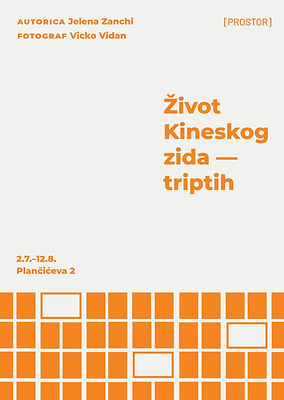
Life of Kineski Zid (Chinese wall) building - Triptych
author: Jelena Zanchi / photographer: Vicko Vidan
July 2nd - August 12th 2022
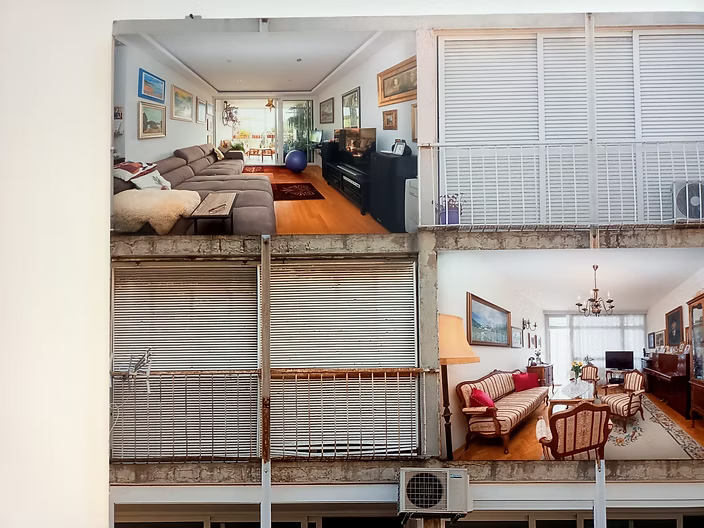
I was born in the same year when this building was built and I have lived in it, with some interruptions, since then. I remember coming home from a night out as a high school student and stopping with my friends by the playground in front of the building to talk a little more before going to sleep. I would then look towards the imposing facade of the Great Wall of China, through which the smouldering of its inner life could be discreetly glimpsed, partially filtered by movable window blinds. Different tones of light in the apartments, the dynamic reflection of the TV show that the residents are watching, parts of the interior, someone's shadow passing by, the sound of moving window blinds that I love so much, as echoes of summer evenings... these are all images and impressions that evoke beauty and the feeling of possibility of quality coexistence of differences. Inspired by these memories, with the work "Life of the Chinese Wall", I wanted to tell a story about life and diversity that is hidden, but also glimpsed, under the modular surface of the facade of the Great Wall of China. This work was designed for the Science Festival and its theme - LIFE. I would like to thank all the tenants who not only allowed us to film their living rooms, but were very interested in the project and enthusiastically supported it. The photos were taken by Vicko Vidan, who was present at all stages of the project development and contributed to the success of the final solution with his technical knowledge and quality suggestions. Jelena Zanchi
_edited.jpg)


Ines Borovac: Collo
August 19th - September 16th 2022
Collo began with the author's wish to dwell deeper into the social complexity of the Croatian and Balkan nation. Thus, the research is not relying on arguments of the written theory but rather using the tools of somatic knowledge to unfold the roots of the patriarchal influence on national bodies. With the case study of Croatian traditional dance, the project is highlighting the patriarchal values of body movements which are represented to the world as a national ideal. As the dances were created by the people themselves, the author is using anthropological approach towards the dances for the better understanding of non-verbal values locked inside of the Croatian bodies. As Nadine Botha depicts: “Even though traditional Croatian folk dances are rarely still danced outside of the stage, bodies are ethnographic archives of movements and behaviours that are inherited across many generations of family, culture and society. Through performative design research in a collaboration with the dance therapist, the author identified the embodied gender and social norms embedded in the Kolo (a basic folk dance popular among Slavic people).” It was then re-choreographed and based on movements that express vulnerability, sexuality and self-expression. Contemporary choreography was created following the feminist aproach of care, understanding and equality. Newly formed dance was led by a female leader, the author herself. Borovac is taking over the role of a leader (kolovođa) using it as a statement towards the shift of the traditional roles. The role of the dance leader was traditionally ultimately a male role, where the most masculine individual in the social circle of the village would guide the whole group of the dancers by voraciously shouting the commands. The commands were mostly directed to the male dancers giving them guides on how to manage the female body whereas in COLLO Borovac uses the power of the role (kolovođica) to encourage the bodies and movements of equality while also giving them space for self-expression. Besides the movements and the choreography, the project also deconstructs the elements of music and clothing. Techno music and embroidered clothing contemporise the project to today’s rave aesthetic. Challenging the often conservative and patriotic field of heritage, the project is changing the context and the audience by placing it in a subculture of an underground society. Contrasting context of the rave environment welcomes the exploration of sexuality and identity, offering the safe space for re-building of individuals far from the national pressure of conservative values. With this being said, the project expresses the need and ability to evolve rather than discard cultural traditions. Performers: Ema Šajatović, Ema Kani, Nino Bokan, Una Matija Štalcar, Vid Vugrinec, Ines Borovac / DJ: Bruno Bolfan / Music Production: Marko Milas / Camera: Urh Pirc Ines Borovac is a social designer and performance artist born in Croatia, currently living in the Netherlands. She holds a Master degree from Design Academy Eindhoven, MA Social design where she developed her practice in the field of performative design. As a performer, Borovac places the body and movement at the core of her work, using knowledge coming from various somatic practices. As a feminist, in her practice she infiltrates various systems regulated by normative values (eg workplaces, traditional rites, religious rituals) with the aim of creating embodied speculative futures. The ultimate goal of Borovac’s work is to re-enact coded movements with a critical approach towards the body, while developing scenarios, tools or spaces that question oppressive social norms. In 2022, together with Ginevra Petrozzi, Borovac co-founded the art-design duo Xsenofemme. The exhibition is part of the Prostor’s programme Rituals, supported by Foundation Kultura nova, Ministry of Culture and Media of the Republic of Croatia and City of Split. Curator: Jasmina Šarić Text: Ines Borovac Technical setup: Marino Vukasović, Ines Borovac Special thanks to Mavena, Queeranarchive and Studio-21-


Morra Ceramics: Life Pause
October 7th - 14th 2022

"Life pause" is a project that gathers and presents the stories and experiences of Ukrainian citizens who fled the war and temporarily settled in Croatia, together with ceramic objects created collaboratively between artists and participants. At the workshops held in Zagreb, Jelsa and Split, the artists collaborated with individuals from the Ukrainian communities, bringing them together to make clay plates decorating them with various plants. During the workshops, the participants were sharing their experiences and stories about leaving Ukraine in the middle of the invasion, about the first moments of the war in their homes, schools, about the changes that sudden and disruptive transitions brought to their lives and the lives of their loved ones. In the process of making clay objects, numerous dimensions and metaphorical meanings of the selected plants were considered, as carriers of memories and emotional impressions in the form of prints in wet clay. "Life pause" in this dimension considers the bonds between people and the hidden meanings and dimensions of the nature, with the aim of creating a safe environment for sharing, but also encouraging the integration of individuals into the social life and culture of the places where the workshops took place. Morra Ceramics is a Ukrainian ceramic duo founded by Anastasia Vishynakova and Yana Guselnikova. They combine ceramics with social activism by sharing stories and messages through the creation and distribution of ceramic objects, often through a workshop format. After fleeing from Kharkiv before the Russian invasion, Nastya and Yana found a new temporary home in Zagreb, where with exceptional power of will and with the help of donations, they restarted their production and social pottery studio. The exhibition was created by LAB852, Održivi otok and Jelsa Art Bijenale.

POTEZ22
Students of architecture and urbanism
November 2nd - 11th 2022

POTEZ22 is an exhibition of works by students of the 1st year of the Graduate Study of Architecture and Urbanism as part of the course Studio 2. The architectural workshop Graduate Studio 2 (DS2) - 2022 was realized through an extensive urban - architectural research on the stretch of Zrinsko - Frankopanska street in Split, which includes the complexes: 'Stari plac' (STUDIO 3), cassette 'Spinut' (STUDIO 6), HBZ Square (STUDIO 4), Poljud complex (STUDIO 6), park 'Turska kula' (STUDIO 1) and 'BRODOSPLIT' (STUDIO 2). POTEZ22 is based on four basic principles: - integrity, because it presupposes a comprehensive assessment of the needs and possibilities of the city and especially of the part of the city in which it is realized, thus overcoming the fragmentary nature of detailed plans, - defined period of time and in a way that, through elaboration and visual presentation, additionally motivates urban actors and attracts investors - partners,- feasibility and presentability, because it plans and coordinates the interventions that are carried out in - flexibility and sustainability, because by assessing the impact of the intervention, it assesses its sustainability in relation to the overall urban context, and already in the programming phase determines solid and immutable elements, as well as those elements that can be changed in the elaboration and negotiation phases or after additional analyses, - participation of all urban actors, transparent procedure and reconciliation of public and private interests (public-private partnership).


Željko Beljan: Gost
November 17th - December 9th 2022

After being exhibited for the first time at the end of last year in the space of the former children's store on Zagreb's Trešnjevka, The Guest is now temporarily residing in Prostor. The two objects, placed in the space which was also once (coincidentally) a shop and now a gallery within the creative hub Prostor, form a site-specific installation - a fictional alien being that completely takes over the interior it inhabits. One of the objects is full of form, expressing strength and almost vital energy, while the other is more passive, as if in a state of hibernation. Their relations and dynamics are affected by the correlation of light and shadow in the space. The resulting composition is of countless variations, and the tangible matter made of hundreds of meters of ropes is contrasted with the immateriality of the shadow, complementing the space which itself becomes an integral part of it. The Guest finds the space as it is and inhabits it, initially as a parasite, but over time this relationship turns into a harmonious symbiosis. In a certain sense, we can also talk about the expanded field of sculpture, which is enhanced by the specific properties of the material used. Such soft and pliable materials, namely, were traditionally used in the production of objects that sought not only to imitate, but also to simulate organic, life-like matter. In addition, at the center of the aesthetic perception of such soft sculptures is the similarity with organic things - living beings that are soft in their structure. They are also characterized by the kinetic potential, flexibility and variability - characteristic of a living organism, or another organic matter of different aggregate states which, in The Guest, can be perceived in composition of the installation itself. The works are created as a series of improvisations using the knotting technique (macrame). Macrame, like embroidery or knitting, is a technique of manual work traditionally considered feminine and is primarily associated with a hobby, rather than artistic activity. Using the same technique, Željko Beljan also creates an art installation on a playground nearby, where he creates a new net on the neglected goal post, similarly as recently at Zagreb's Žitnjak (work Three Corners Penalty). This non-standard net in fact fulfills its basic function. While The Guest temporarily inhabits and adapts, this installation is permanent. But in contrast to the work in the gallery, which from the practical domain enters the realm of the fantasy, this work due to its functionality, approaches and examines the boundaries of applied and fine art even more. The outsiderness is present not only in the choice of technique but also in the concept itself. In the time of total fetishization of football, the work reflects a true love for that sport and game, which is also evident in the very inauguration of the work - a friendly invitation to play and participate, where the "audience" becomes its integral part and its meaning. Željko Beljan (Vukovar, 1984) is an artist with a primary interest in working with textiles. In 2021, he completed his graduate studies in New Media at the Department of Animated Film and New Media of the Academy of Fine Arts of the University of Zagreb. Through his artistic work, he explores the phenomenon of handwork and its position in contemporary art, as well as soft art, folk and outsider art. Since 2011, he has participated in a series of juried and group exhibitions in Croatia and the region. His solo exhibitions so far: Benjamin Beljan: Željko (Kamba Garage, Zagreb, 2022); Benjamin, 2021 (CEKAO Gallery, Zagreb, 2022); Myth, Embroidery and Vuteks (NMG@Praktika, Split, 2020; Karas Gallery, Zagreb, 2020); Cartoon Core (Siva Gallery, Zagreb, 2018; Inquiry Inc., Osijek, 2016). He was the participant of the WHW Academy educational program, generation 2022. Lives and works in Zagreb. The exhibition is part of the "Craft as a form of resilience" program which "Culture Hub Croatia" Platform is implementing in 2022 as part of the Prostor creative hub. The program is co-financed by the Kultura nova Foundation, the Ministry of Culture and Media of the Republic of Croatia and the City of Split.


Platforma za eksperiment 3.1
December 14th 2022 - January 20th 2023

Lara Badurina, Liberta Mišan and Sara Salamon, at the invitation of the Platform "Culture Hub Croatia" in 2022, conducted artistic research that, through residential stays, included mapping locations, surveying citizens and recording actions in public space, which then became the basis for an experimental short movie. The spatial and physical pollution during the tourist season was the first trigger in the experimental work process. In parallel, postcards about these spaces and a short booklet accompanying the process were created, and together formed an art installation presented in this exhibition. PLATFORM FOR EXPERIMENT began its work in 2017 with the aim of exploring the particularity of space through merging of contemporary practices within the artistic field; performing and visual arts. Numbered with place markers and the order of execution, the platforms are continuously implemented with fluid changes of members/initiators, depending on the interest and achieved results of the research of places, cities and their urban landscapes. The programs of the platform for experiment include public, urban spaces, several of them at the same time or by choosing a key one, with the aim of revitalizing and raising awareness of the urban space. The field of action is also a field of fusion that includes scenic and ambient spaces of various media installations such as sound and light installations through actions, events, performances and plays. The "Platform for experiment 3.1" program is supported by the Ministry of Culture and Media of the Republic of Croatia and the City of Split. The work of the "Culture Hub Croatia" Platform is supported by the Kultura nova Foundation. Curator: Jasmina Šarić Technical setup: Lara Badurina, Liberta Mišan, Sara Salamon


