EXHIBITIONS 2026
Jasminka Končić: Subversive Embroideries: I Should Have – I Could Have – I Didn’t…
March 8th - 24th 2026
.png)
The exhibition Subversive Embroidery: I Should Have – I Could Have – I Didn’t… is an intimate record made in the medium of textiles. Primarily, the exhibition can be read as a feminist-connoted artwork. The work problematizes the questioning of women’s personal freedom of decision-making and action, their independent making of the right decisions, as well as the stereotypical reception of criticism without considering the real weight of the words spoken by the other party. The exhibition speaks of the often silent and silenced answers to questions that invade the sphere of the intimate inner space of the female personality. What is spoken is often subject to patterns of learned male-female behavior and their unconscious acceptance, both by those who say them and by those who receive them. The exhibition is conceived in the form of directed questions and comments and unspoken, inaudible answers to them. Through the form of three aggressively and insolently connoted questions and passively given answers, the goal is to raise awareness of established forms of male-female verbal communication that can develop into unhealthy forms of communication. Likewise, the hand-embroidered answers contain regrets for everything that was not done, and perhaps should have been. Questions and comments are printed in white text on red rough mats, while answers-reactions are embroidered in the form of textile embroidery and tapestry in red and pink. In this way, we get the contrast of two textile media, production techniques (serial-produced doormat and hand-woven textile embroidery) as well as the contrast of colors. The textiles come in three pairs where a mat placed on the floor follows the response in the medium of hand embroidery on the wall. The pairs are as follows: YOU SHOULD - I SHOULD, YOU COULD - I COULD, WHY YOU DIDN'T - I DIDN'T. The colors that run through the exhibits are red, pink and white. While the mats have uniformly red backgrounds and the text is consistently written in white, the colors of the background and letters change on the tapestries. In the color scheme, there is a rule of repeating aggressive red in both the tapestries and the mats, while the “feminine” pink is used exclusively on the tapestries, as is the neutral white that was used exclusively on the mats. The medium of the textiles used in the realization of the works for the exhibition is twofold: industrially made mats with a rough texture with a defined typography that serves to make the text easy to read, while hand embroidery in the form of a tapestry represents an intimate, gentle writing, there is no strict typography, but the design of the text is defined by the limitations of the textile medium and the individual design of the letters, creating an individual writing and personal typography. Jasminka Končić (1973, Zagreb) graduated in graphic design in the class of Professor Miroslav Šutej at the Academy of Fine Arts, University of Zagreb in 1997. She completed her postgraduate studies in 2012 at ALUO (Academy of Fine Arts and Design - University of Ljubljana, Slovenia). She received her master's degree in the class of Assoc. Prof. Alen Ožbolt on the topic Two-dimensional textile materials and processes of translating them into three-dimensional sculptural forms. In the same year, she enrolled in doctoral studies in the field of fashion design at NTF (Faculty of Natural Sciences and Engineering, University of Ljubljana, Slovenia), from which she received her doctorate in 2019 with the topic The use of the language of fashion and clothing in contemporary art under the mentorship of Assoc. Prof. Dr. sc. Nadja Zgonik. She is a full professor at the Faculty of Textile Technology, University of Zagreb, where she teaches courses in the field of fashion and textile design. She is a member of the Croatian Society of Fine Artists (HDLU, Zagreb). She has received several awards for her artistic and pedagogical work. In her artistic works as well as in her theoretical research, she studies the role of the language of fashion and clothing in contemporary visual art. Through the medium of clothing and textiles and her theoretical research, she examines the connotative meaning of clothing, fashion and anti-fashion in the field of 20th century art movements and contemporary artistic practice, placing a special focus on the performative character of clothing fashion. Program curator: Jasmina Šarić / Exhibition setup: Jasmina Šarić, Jasminka Končić / Assistants: Željka Ivančić, Unda Kreišmane / Graphic design: Kristina Tešija The exhibition is organized as part of the annual gallery program of the creative hub Prostor entitled “Unknown: objects, places, time” and is financially supported by the Ministry of Culture and Media.


Drawing With Light
Exhibition of student works created at the scenogram and luminogram workshop led by artist Marta Djourina
March 27th - April 8th 2026

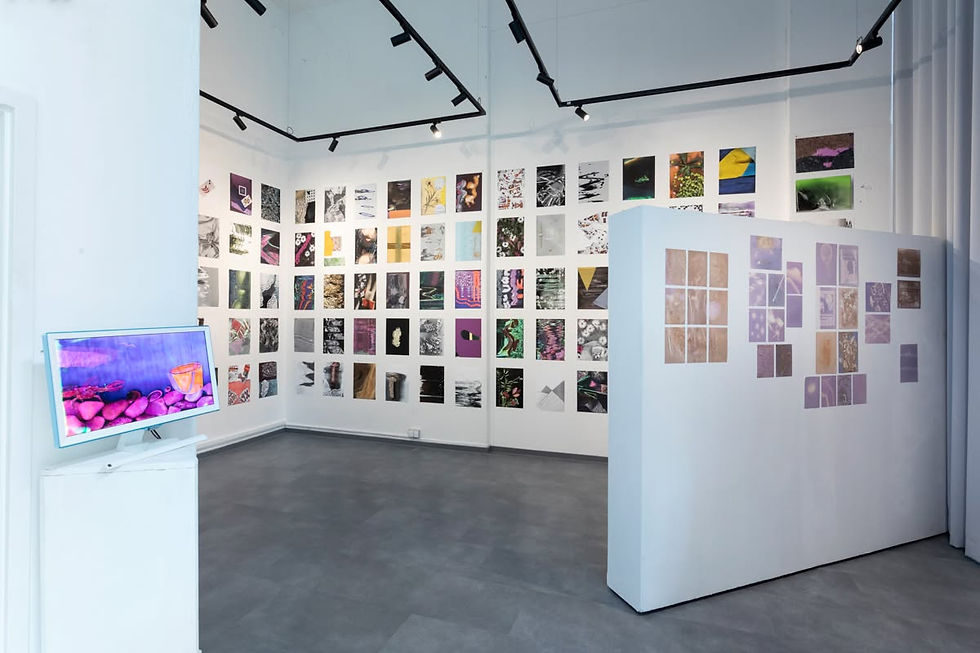
Artists: Marija Baselli, Ana Bonacin, Petra Crnjac, Anamaria Crnoja, Lora Cukrov, Nika Grdan, Nina Grebenar, Viktorija Ivelja, Jelena Jurčević, Júlia Macáková, Augustina Maslov Vidaković, Ana Matas, Josipa Nedeljko, Đina Radulj, Antonela Šaban, Leonora Ugrin In a two-day workshop led by visual artist Marta Djourina, the students explored photography without a camera. On the first day, using a flatbed scanner, the students created scanograms, experimenting with layering, movement and digital distortion. On the second day, they created luminograms, camera-free images created by directly exposing photographic paper to sunlight. Working with found materials and transparent foils, the students drew and painted with light. Marta Djourina (Bulgaria/Germany) explores light as a theme, tool and object of research in her practice. Working with large-format analog photographic paper, she transforms the photo lab into a performative stage, using various natural and artificial light sources — from bioluminescence to flashlights and lasers, and long exposures — to “draw” on the surface of the paper. Merging photographic and painterly gestures, her work balances precision and unpredictability. She redefines photography as a physical act and a trace of movement in time. The workshop was attended by students from the Fine Arts Department of the Split Academy of Arts (Arts and Visual Arts, Painting, Visual Communication Design, Film and Video). Organization: Assoc. Prof. Art. Lana Stojićević, Department of Visual Culture and Fine Arts, Art Academy in Split and Culture Hub Croatia/Creative Hub PROSTOR, Split The activity was co-financed by the European Union through the National Recovery and Resilience Plan (NextGenerationEU) as part of the project Contact: Art in the Community - KUZ, IP-UNIST-56 of the Art Academy in Split, the Creative Europe program (Craftwork 4.0 All Culture Hub Croatia project) and the Culture Moves Europe program. The views and opinions expressed are solely those of the author and do not necessarily reflect the official views of the European Union or the European Commission. Neither the European Union nor the European Commission can be held responsible for them. The exhibition was co-financed by the Ministry of Culture and Media and the City of Split. The work of the Platform "Culture Hub Croatia" is supported by the Kultura nova Foundation and the National Foundation for the Development of Civil Society.


Mila Dobrevska: A Familiar Cosmos
June 6th - 26th 2026
*in cooperation with the DENES award from North Macedonia

Focused on experimenting with ceramics and glass manipulation, Mila Dobrevska’s one month residency in Prostor culminated in an installation that transforms the exhibition space into an immersive nocturnal environment. Utilizing UV illumination and neon-activated pigments, the installation transcends mere representation. Instead, it constructs a heterotopic, nocturnal environment where the celestial body is reconfigured as an artificial constellation suspended between memory, myth, and tangible affect. Inspired by childhood memories of phosphorescent stars placed on bedroom ceilings, Dobrevska reflects on the human tendency to seek refuge, meaning, or perspective in the night sky. The work thus interrogates the human impulse to domesticate the sublime—transforming infinite cosmic space into a protective, localized horizon of care. Dobrevska's practice addresses the dialectic between the monumental and the intimate, framing the cosmos not as a neutral void, but as a site of existential grounding and historical continuity. Across generations, people have looked toward the stars in search of orientation, reassurance, ritual, or contemplation of their own fragility within the universe. Through this tension between the monumental and the intimate, the work considers the continuity of human perception across time. Across historical epochs, the celestial expanse has functioned as a primary semiotic canvas for human orientation, ritual, and existential contemplation. Dobrevska explores how this apparatus of perception shifts; the same stars that once informed navigation, storytelling and systems of belief now collide with contemporary scientific rationalism and the spatial alienation of light pollution, which increasingly severs humanity's visual access to the night sky. The installation’s conceptual architecture synthesizes regional ecology, local historiography, and art-historical lineages. Forms are inspired by Croatian flora and fauna and regional heritage alongside classical iconographies of the cosmos, most notably to the luminous, proto-spatial celestial motifs of the Mausoleum of Galla Placidia. This specific reference bridges the artist’s Macedonian Byzantine roots with her formative training in Ravenna, the historic center of mosaic practice. Through this cross-cultural synthesis, the work dismantles the sky as a natural given, repositioning it both as an image and a cultural construct. Ultimately, through the shifting dynamics of fluorescence and luminescence, the installation destabilizes the distinctions between memory from fiction, archaeology and contemporary material culture. The exhibition space becomes a threshold of destabilized perception, inviting the spectator into an environment where collective historical memory and localized personal recollection continuously fold into one another. Mila Dobrevska (1999) in her artistic practice is often guided by a strong sensitivity and a deep need for expression, exploring identity, existence and human emotionality. The figure, stylized and abstracted, in her work functions as a symbol of the inner state and personal narrative. Combining painting, mosaic, sculpture, installation, textile and fabric, her work combines the traditional with the contemporary, turning everyday moments, folklore and collective memory into spaces for re-examination and escape, sources of resistance and renewal, which encourage her to reconnect with her own inner core and joy in existence.She participated in numerous international exhibitions, including the Biennale of Contemporary Mosaic in Ravenna,Italy (2019–2025), the 57th International Film Festival Mostra del Nuovo Cinema in Pesaro, Italy (2021), IV Festival of Mosaic in Belgrade, Serbia (2024), MuseoDiffuso.exe in Sant'Antioco, Italia (2024), Prieuré de Cayac in Bordeaux, France (2025), Glass Experience in Dolenjski Museum in Novo Mesto, Slovenia (2025), solo exhibitions such as in the National Gallery of R.S. Macedonia - Mala Stanica in Skopje (2024), Pioneri Gallery in Skopje (2025), A Pick Gallery in Turin (2026), Robevci Family House, National Museum of Macedonia in Ohrid (2026) and more.Dobrevska completed her undergraduate and master's studies at the Academy of Fine Arts in Ravenna, Italy, with a focus on contemporary mosaics. She is a member of the Society of Fine Artists of Macedonia and MARTE (Association for Contemporary Mosaic) in Ravenna. She is one of the finalists of DENES award 2025. Mila Dobrevska's residency was organized in cooperation with the DENES award from North Macedonia, part of the international YVAA (Young Visual Artists Awards) network. The exhibition is part of the Prostor gallery's annual program, co-financed by the Ministry of Culture and Media of the Republic of Croatia and the City of Split.


Martina Cioffi: I Primi Pensieri del Mondo
July 4th - August 21st 2026
_page-0001.jpg)
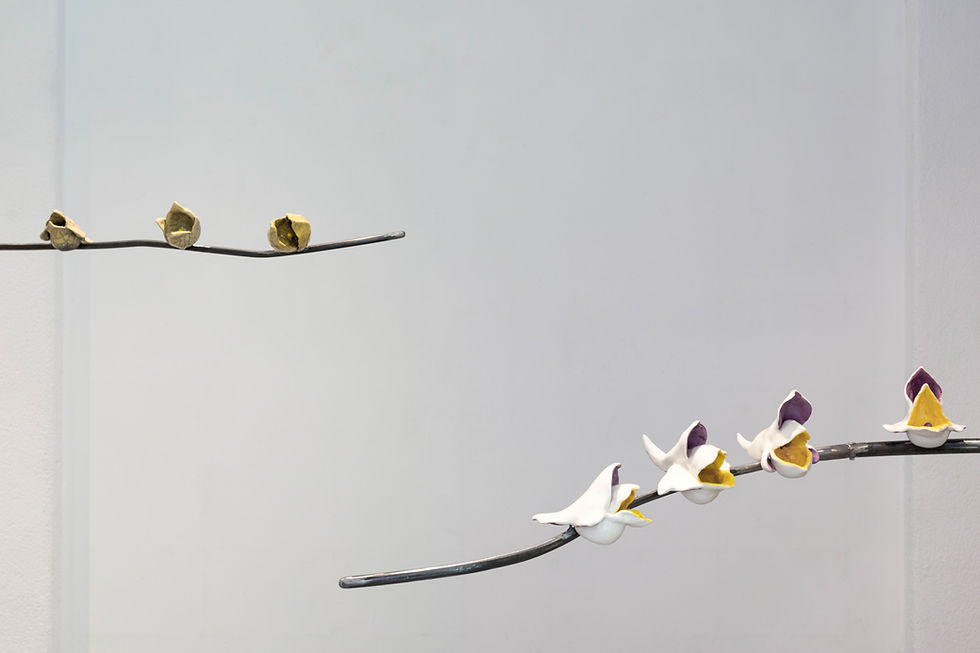
Developed during her residency in Split earlier this year, Martina Cioffi’s project takes its title, I primi pensieri del mondo (The First Thoughts of the World), from the evocative verses of poet Giorgio Caproni, who describes a potent, primordial image of dawn—the precise, fragile moment when the world awakens, light breaks, and the morning's first bird songs pierce the silence. For Cioffi, this daily awakening functions as a continuous origin, a threshold where the world is born anew each time. The work traces a poetic lineage of the city of Split through two foundational plants deeply embedded in its landscape and material identity: the broom (Spartium junceum, known locally as brnistra) and the acanthus (Acanthus mollis, or akant in Croatian). Found thriving side by side within the garden of the nearby Archaeological Museum, these botanical specimens frame a conceptual dialogue between the untamed natural world and the historic weights of human construction. The broom, with its radiant, sun-like yellow blossoms, carries the mythic origin of the city’s ancient Greek name, Spálathos. Before the physical city existed, there was possibly only this luminous natural image: a wild topography flooded by golden light. Conversely, the acanthus represents the triumph of architecture over the organic. Carved into the Corinthian capitals of Diocletian’s Palace—the very nucleus of Split—the living plant was historically petrified into stone, trading its biological vitality for structural permanence and formal order. Cioffi operates within the fertile tension between these two poles: nature and architecture, spontaneous growth and calculated construction. Disrupting classical tradition, the installation intentionally privileges the flower over its iconic leaf. While the leaf has long symbolized stability and architectural rigidness, the flower introduces time, ephemerality, and reproduction. Through this shift, architecture sheds its static permanence, becoming something fluid, unstable, and generative. In the gallery space, two elongated iron stems emerge directly from the architecture, reaching out into the room. Perched upon them are delicate ceramic flowers, resembling small birds frozen in a moment when they are about to sing. They are not just flowers, but figures suspended between the vegetal and the animal, between silence and voice, between stillness and awakening. Enveloped by a soft, artificial fog that blurs the boundaries of the physical environment, the installation transforms the room into a dream-like, pre-architectural sanctuary. This environment exists both before and beyond human fabrication—a speculative landscape where the city dissolves back into its vegetal origins, collapsing the act of building into a simple gesture of growth. Lalliginosa l’alba nasce sulle colline, balbettanti parole ancora infantili, la prima luce. La terra, con la sua faccia madida di sudore, apre assonnati occhi d’acqua alla notte che sbianca. (Gli uccelli sono sempre i primi pensieri del mondo). _ installation glazed and lustred ceramics, raku ceramics, iron, vapour 2026 --- Martina Cioffi (Como, 1991) explores the transformative and resilient capacities of plant life, translating them into a symbolic reinterpretation of landscape and of the relationship between humans and nature. Her work constructs imaginary worlds in which archetypal elements become symbolic devices that evoke an ancestral, generative, and interconnected nature, where psychic dimensions and material reality tend to converge in an attempt to restore a sense of enchantment. Her practice develops through site-specific installations conceived in dialogue with the genius loci. She was selected for the 63rd Faenza Prize at the International Museum of Ceramics in Faenza (MIC) and for the Pini Art Prize. Recent projects include Regina, a permanent artwork for Monte Barro Regional Park; the solo exhibition Hortus Nocturnus at SpazioSERRA; participation in the residency program A dimora (Londa, Florence); and the site-specific intervention Diorama for Platea in Lodi.


Bitter Herb, Healing Hands
curator: Amy Melling
artists: Cigdem Boru, Karla Crnčević, Ana Hušman, Armina Pilav
September 15th - 23rd 2026
Bitter Herb, Healing Hands explores how ecological knowledge is remembered, carried and transformed through rural traditions and everyday acts of care. In an increasingly changeable world, shaped by technological, socio-political and climatic shifts, the exhibition considers how knowledge is passed between generations through informal archives - gestures, stories, recipes, landscapes, food and relationships. These forms of knowledge are rarely fixed or formally documented. Instead, they are lived, repeated and adapted, embedded within the rhythms of everyday life. This collection of works considers how we hold on to this embodied knowledge. This might happen through material forms such as herbs, foods and tinctures, or through acts of remembering and sharing, such as moving image, storytelling and making. Bringing these different forms together, Bitter Herb, Healing Hands asks what survives, what changes and what is lost. Ana Hušman’s film I Would Rather Be a Stone surveys the ecological surroundings of Lika, a neglected and sparsely populated region of Croatia. Narrated by the protagonist Little Jela, an embodiment of generations of women from Hušman’s family, the film follows the changing landscape of dense forest and lichen-covered rocks in the wake of the construction of a new hydroelectric power plant in the Kosinj Valley. Lika was heavily affected during the Second World War. Its population was poor and the land difficult to cultivate, and much of the generation born in the 1940s subsequently moved to the cities. More recently, the construction of the Kosinj Hydroelectric Power Plant threatens to submerge two villages by 2028 - Gornji Kosinj and Mlakva. Places that once supported more than a thousand inhabitants have already dwindled to barely 150 permanent residents. Kosinj is a landscape in which people, agriculture, plants and the surrounding environment have developed together over centuries. Flooding the valley will mean removing not only buildings, but the context in which many of these practices have meaning. Hušman’s film captures this tension of cohabitation, where human and non-human lives exist alongside one another within a landscape undergoing irreversible change. Here, memory becomes phenomenological, shaped by the subjective experience of time. For the forest, memory is long, stretching across generations; for the power plant, it is fast and disruptive. Hušman examines how memories are constructed and how they fracture, using cinematic techniques that echo this fragmentation. Lichen becomes a quiet constant within the film - seemingly immobile, persisting through a landscape in revision. In contrast, Cigdem Boru’s The Season We Keep is colourful and immediate, filmed only a few weeks ago during harvest season in Türkiye. Drawing on her Pomak heritage, Boru traces the continuation of domestic rituals carried across generations through the Balkan diaspora. The work moves from her grandmother’s handmade lace and embroidery, to her mother’s cultivation of the land, and finally to the artist’s own acts of observing, documenting and reinterpreting. Set in the artist’s mother’s garden, we follow acts of growing, harvesting, preparing, drying and storing food for the months ahead. The women talk and work as though the tasks are second nature. Their shared labour, interwoven with laughter and conversation, reveals a sense of intimacy and matriarchal connection. Through these everyday acts, their relationships to the land and to one another become visible. Compositionally echoing Hušman’s work, The Season We Keep layers and interweaves imagery, symbols and objects to trace generations of female memory. Boru’s work asks how ancestral knowledge, often carried through everyday, multisensorial acts, might be captured without losing its texture, authenticity and ambiguity. Rather than attempting to hold time still, The Season We Keep understands continuity as something active. What passes from grandmother to mother to daughter changes as it moves, shaped by nature, renewed with each season, carried forward through everyday life. This movement between language, plants and lived experience is echoed in Karla Crnčević’s Love From the Border. The work takes the form of three letters, each addressed to a plant or flower. Alongside the writing, the plants themselves are dried and presented as part of the work. Originally produced as part of BAR Bidasoa Art Room, Bitamine’s residency programme in 2023, Love From the Border has been recontextualised for Bitter Herb, Healing Hands, with many of its references taking on expanded meanings in the landscape of Split. Here, the letters become a way of acknowledging the present - wildfires spreading along the coast, the recent ecological crisis in Lika. The plants themselves become carriers across borders, connecting places, memories and histories. Crnčević considers how we classify and remember the natural world, and how these acts of classification are shaped by the social, cultural and political frameworks through which we understand it. By addressing plants directly, the work challenges the distance usually present between the botanist and their sample. The plants become subjects with which to correspond, rather than objects to describe. Further, the act of writing to them creates a relationship based on attention, encounter and exchange. Armina Pilav’s workshop Island Food in 52.143 Seasons extends the exhibition through taste, scent and touch. Drawing on the agroecological practices of Pilav’s family business, Divja Herbal Crafts OPG, and their relationship with the land on Brač, the workshop explores the wild herbs and fruits of the island through healing remedies and food-making. The title reflects the many rhythms of Brač’s local food system and the knowledge held within it. Foraging, cultivating olives, almonds, figs, lavender, helichrysum, cherries, citrus, grapes and more, as well as caring for sheep and goats and making cheese, are all part of an ongoing relationship with the land. These practices embody knowledge that is learned through doing and shared through everyday life. Through tasting and exploring herbal remedies and foods made through traditional processes, participants encounter ecological knowledge as something to experience, share and carry forward. Across these works, what survives is not a fixed record of the past, but knowledge continually reshaped through memory, relationships and the land we share. ____ Amy Melling is a curator and producer whose practice explores the intersection of ecology, place-based knowledge and contemporary art. She is interested in how knowledge is carried beyond institutions through memory, movement and oral histories. Alongside her independent practice, Amy is a member of the curatorial collective Shed Project, which has delivered exhibitions and projects as part of Folkestone Triennial and Wandsworth Arts Fringe, and in collaboration with SLaM NHS Foundation Trust. She is also Exhibitions Producer at London College of Communication, where she stewards the university's gallery programme, supporting exhibitions as sites for learning, experimentation and collective enquiry. Cigdem Boru is a London-based visual artist working across photography, still life, and installation. Her practice explores memory, material culture, and female identity through inherited objects, domestic rituals, and cultural symbolism rooted in her Pomak heritage and the wider Balkan region. Her work reflects on themes of cultural inheritance, women’s labour, ritual, and belonging, transforming familiar domestic materials into contemporary visual narratives that connect personal experience with collective mythology. Cigdem holds an MA in Fine Art Photography from London College of Communication, University of the Arts London. Her work has been exhibited in the UK and internationally, bringing together photography, installation, and material-based practices to explore the relationship between cultural memory and contemporary visual language. Karla Crnčević is a filmmaker and dramaturg whose practice is situated at the intersection of cinema, archives, and spaces of memory. She works across cinema, research, and curating, and is one of the founders and programmers of KINO UNSEEN, a platform dedicated to rethinking film circulation, cultural policies, and the reactivation of cinema spaces as places of encounter. Her work moves between documentary and experimental forms, often through collaborative and process-based approaches. Ana Hušman’s practice disassembles the structures and textures of cinematic elements through film, installation, books, sound, image and text. Hušman experiments with the possibilities of animation, documentary and fictional cinematic methods, and the possibilities of the recorded voice and its articulation. Her working process questions and plays with the positions of the amateur and the professional subject of performativity, the medium itself, and the structures that dictate and produce patterns of behavior. She is Professor at the Department of New Media at the Academy of Fine Art in Zagreb, cofounder of the documentary film organization RESTART where she has been holding film education programs for children and young people for many years. Armina Pilav is conceptual architect, artist, herbalist and artisan cook based in Ložišća on the Island of Brač. Her land practice evolves in the Divja Plant Sanctuary and OPG Divja where together with her family, she is taking care of 200 olive trees, forage wild plants and fruits. In the home garden she cultivates different medicinal plants and vegetables. Following all year round cultivating and foraging of herbs and fruits, intentionally small EV olive oil production, Armina also produces herbal remedies, natural cosmetics, fermented and vegan/vegetarian food made only from the local products. Her interests in the island food systems brought her attention to the traditional methods of food preservation, plants diary writing, observation of climate and technological impacts on the everyday food production, edible herbarium making, hosting cooking and herbal workshops, shared tables and narratives about the island landscape and food. _____ The programme is supported by the Ministry of Culture and Media of the Republic of Croatia and the City of Split


